
.svg)
EOR vs entity canada: when to hire without setting up a legal entity

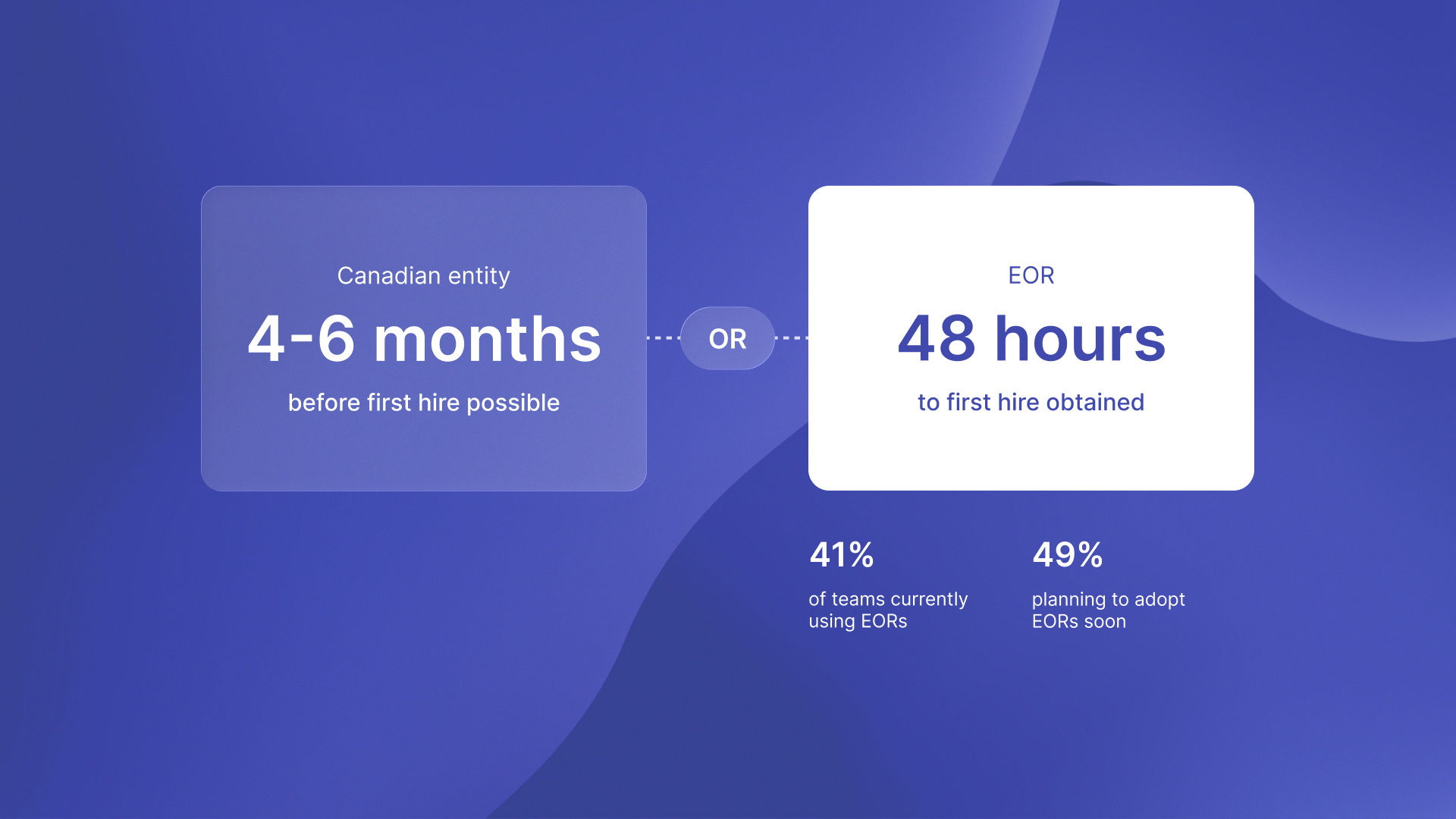
You're ready to hire your first Canadian developer. You've found the perfect candidate. Now you're stuck deciding: spend 4-6 months setting up a legal entity, or onboard them in 48 hours through an employer of record?
Most U.S. tech leaders default to whichever option their lawyer or accountant mentions first. That's not a strategy. The EOR vs. entity decision needs a clear framework that weighs four factors at once. These are headcount plans, timeline urgency, budget limits, and compliance risk tolerance.
This guide provides specific thresholds that make the choice clear.
Why EOR adoption is accelerating as the default entry strategy
The global EOR market grew from $5.02 billion in 2025 to $5.35 billion in 2026. Today, 41% of teams use EORs.Also, 49% plan to adopt them (Slasify EOR Market Report). Distributed teams are choosing EORs because they solve two critical problems: compliance risk and entity setup cost.
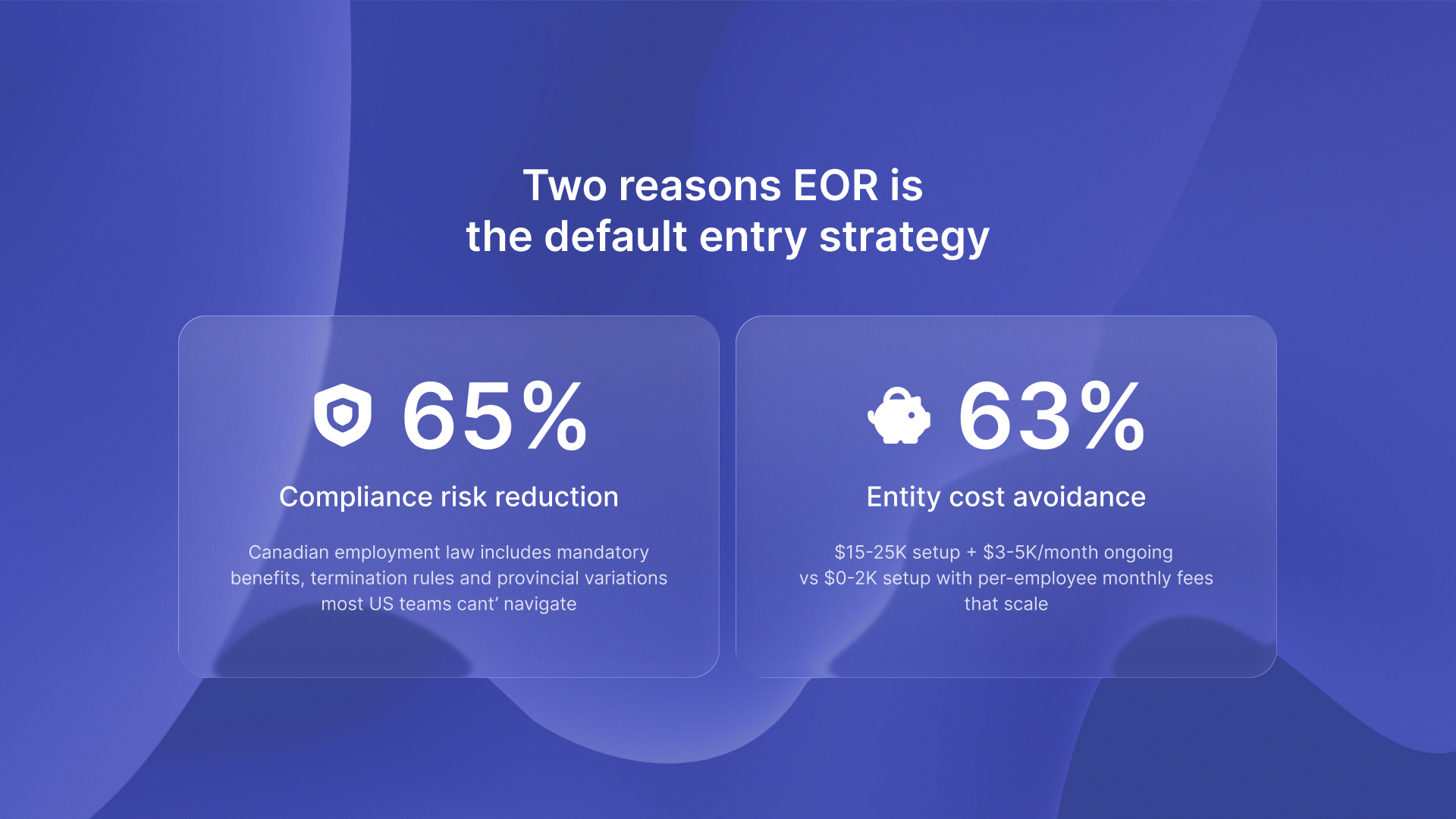
65% of companies use EORs to cut regulatory and compliance risks. 63% use them to lower the cost of setting up and maintaining local entities (Atlas HR Survey). The decision isn't just about speed. It's about mitigating exposure while maintaining capital efficiency during early-stage Canadian expansion.
The 1-30 employee threshold where EOR cost-effectiveness peaks
EOR is often more cost-effective for teams with 1 to 30 employees. Beyond that size, companies often consider setting up a legal entity (Employsome EOR Market Analysis). The economics shift because entity overhead becomes diluted across larger headcount, while EOR per-employee fees compound.
How the math works
A Series A SaaS company hiring 3 backend engineers in Toronto pays roughly $1,200-1,800/month in EOR fees total. Setting up a Canadian entity costs $15,000-25,000 upfront, plus $3,000-5,000/month in ongoing compliance, payroll, and accounting costs. The EOR breaks even at month 10-15, but only if you factor in the 4-6 month delay before the entity is operational.
The timeline creates material opportunity cost
EOR enables 48-hour onboarding versus 4-6 months for entity establishment. In competitive hiring markets, that delay means losing top Canadian tech talent to companies that can move faster. The cost of a missed hire often exceeds the cost difference between EOR and entity for an entire year.
The four-variable decision framework
Headcount trajectory
If you're hiring 1-10 employees in the next 12 months, EOR is the clear choice. If you're planning 20-30 employees within 18 months, start transition planning now. The inflection point isn't just total headcount, it's growth velocity. A company that hires 2 to 3 Canadian employees each quarter should use an EOR. It should keep using an EOR until it has 15 to 20 employees. Then it should review setting up an entity. The EOR can still cover new hires during the transition.
Timeline urgency
If you need to onboard within 2-4 weeks, entity setup isn't viable. If you have 6+ months runway before the first hire starts, entity setup becomes feasible. Most venture-backed startups fall into the first category. They're hiring to hit growth milestones, not administrative timelines.
Budget constraints
EOR requires minimal upfront capital:
- $0-2,000 for setup
- Monthly per-employee fees that scale with headcount
- Zero ongoing infrastructure costs
Entity setup demands $15,000-25,000 upfront plus ongoing monthly costs that don't scale with headcount initially. Early-stage companies preserving runway should default to EOR. Growth-stage companies with established finance operations can absorb entity costs if headcount justifies it.
Compliance risk tolerance
Canadian employment law includes mandatory benefits, termination notice requirements, and provincial variations. EOR providers like Shoreline handle compliance monitoring, reducing risk for teams without Canadian HR expertise. If your team lacks in-house Canadian legal/HR resources, EOR significantly lowers compliance exposure during the learning curve.
When to transition from EOR to entity
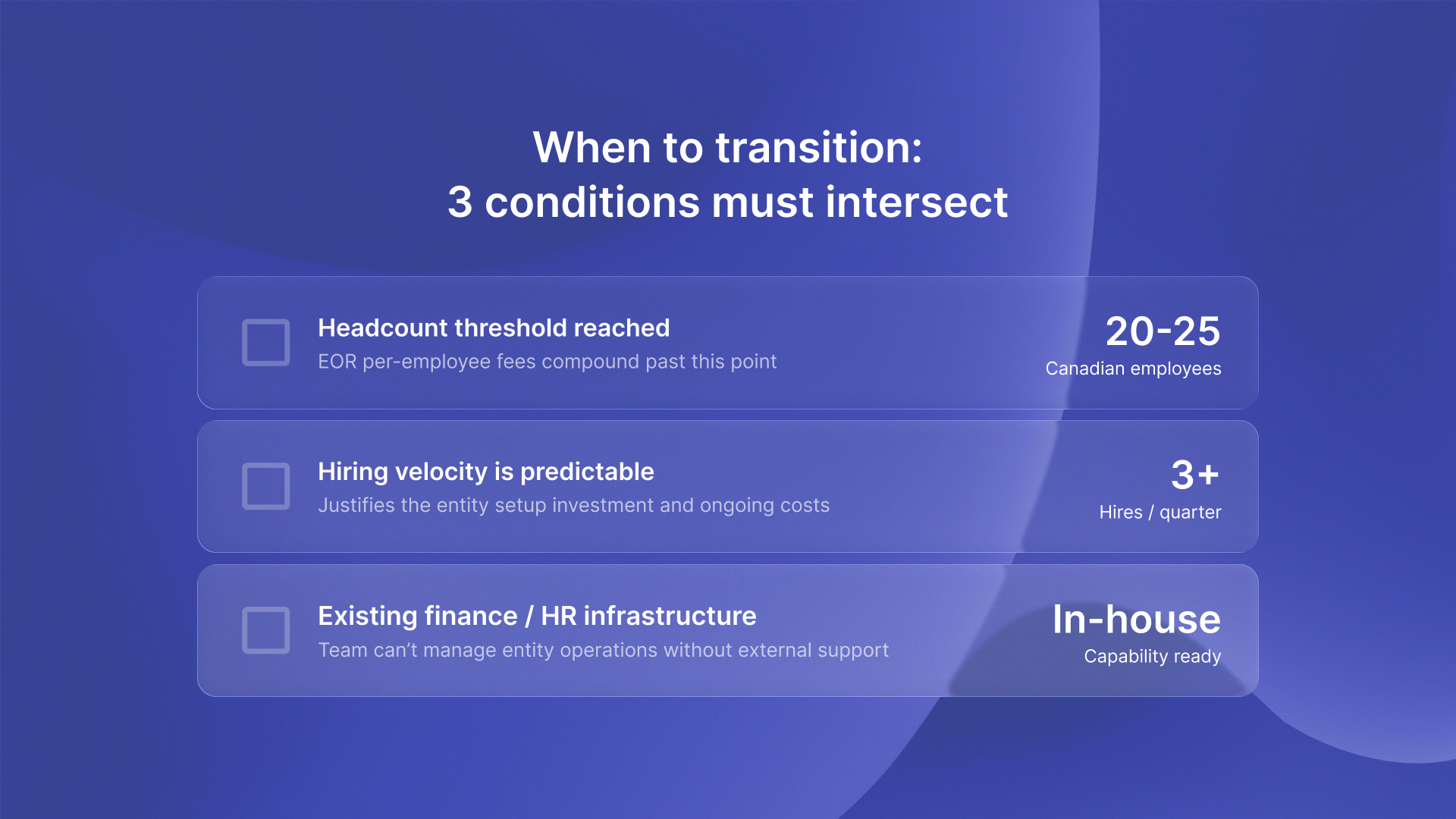
The transition trigger isn't a single number. It's the intersection of three conditions:
- You've reached 20-25 Canadian employees
- Your hiring velocity is predictable (3+ hires per quarter)
- You have finance/HR infrastructure to manage entity operations
A growth-stage fintech in Canada should start entity setup when it reaches 15 employees. This allows 4 to 6 months for formation. During that time, it should keep EOR coverage for new hires as it grows from 8 to 25 employees. The entity becomes operational as headcount approaches 25, minimizing disruption.
The phased approach mirrors the go-to-market strategy planning that growth-stage companies use when entering new markets. Just as GTM strategy requires timing coordination across sales, marketing, and product, the EOR-to-entity transition requires coordination across legal, HR, and finance.
What to do next
For teams in the 1-10 employee range with timeline pressure, EOR is the optimal path. Shoreline offers 48-hour onboarding with specialist Canadian expertise, allowing you to secure talent before competitors complete legal setup. For teams approaching the 20-30 threshold, start transition planning 6 months before you expect to cross 25 employees.
Not sure where you fall in the framework? Map your headcount trajectory against your timeline and budget constraints. If any variable points to EOR, that's your answer for now. The decision isn't permanent. It's a staged approach that matches your growth phase.
As your hiring strategy grows, think about how optimizing for AI-powered search visibility can help. It can help you attract Canadian talent naturally. The same frameworks that help you make EOR vs entity decisions apply to building discoverable employer brand content.

.png)


.png)




%2520(8).png)