
SR&ED 2026 vs 2025: what actually changed


TL;DR
- The 35% refundable SR&ED credit now covers up to $6 million of spending a year, up from $3 million. Bill C-15 made it law on March 26, 2026.
- The new rules apply to tax years starting on or after December 16, 2024, so for most companies the 2025 claim filed in 2026 already uses them.
- The phase-out now runs from $15 million to $75 million, eligible public companies can earn the 35% rate, and R&D equipment counts again.
- Since April 1, 2026, companies under $25 million in gross business income can ask CRA to pre-approve a project before they spend on it.
- If your engineers are employed through an employer of record, check with the EOR and an SR&ED adviser before you count on any refund for them.
Canada's best R&D tax credit used to stop at $3 million of spending. Now it stops at $6 million, and a few other rules moved with it.
Bill C-15 became law on March 26, 2026. It doubled the limit for SR&ED's 35% refundable credit to $6 million, raised the phase-out range to $15 to $75 million, opened the credit to eligible public companies and made R&D equipment claimable again. Since April 1, CRA also lets smaller companies get a project approved before they start.
Quick refresher: SR&ED is Canada's federal tax credit for research and development done in Canada. Qualifying businesses earn 15% back on eligible spending, and some corporations earn 35%. For Canadian-controlled private corporations (CCPCs), that 35% is refundable, so CRA pays it out even if you owe no tax.
The changes side by side
Sources: Budget 2025 release, Department of Finance, EY's Bill C-15 summary.
The new rules already cover 2025

They apply to tax years starting on or after December 16, 2024. For a company with a December year end, that's 2025, so the claim you file in 2026 is the first one under the new limit. If your accountant worked up those numbers before the law passed, ask them to check again.
Who actually benefits
The bigger limit only matters once your R&D spend passes $3 million. Take a hypothetical Toronto CCPC with $4.5 million of qualifying work, mostly engineering salaries. Under the old rules it could get $1.05 million back in refundable credit. Under the new rules it's $1.575 million. A seed-stage team spending $600,000 sees no difference. (Federal only, simplified, before provincial credits.)
The wider phase-out helps companies that have raised a sizeable round and used to lose part of their limit for it. Equipment eligibility mostly helps hardware teams: test rigs, lab gear, GPUs bought for experiments. If your team runs entirely on cloud services, expect less from that change.
Getting a project approved first
Since April 1, 2026, companies with under $25 million in gross business income can ask CRA to confirm a planned project qualifies before spending on it. You can submit up to three projects, approval lasts up to three years, and a claim made up only of approved projects gets a faster 90-day review if CRA picks it. It's optional, it doesn't check your numbers, and you still file a normal claim afterwards.
What still doesn't count
The eligibility test hasn't moved: the work has to happen in Canada, aim at a technological advance and involve real experimentation. The exclusions haven't moved either. Marketing and sales are out, so whether your go-to-market comes from full-time hires or fractional specialists through GrowTal, keep it out of the claim. Commercial production is out too: launching a private-label line with Blanka is real work, but it isn't experimental development. And CRA won't count hiring experts to apply what they already know.
Other funding, like NRC IRAP, still reduces the credit. Provincial credits follow their own rules, and Quebec runs its own system, so check those separately.
If your engineers are in Canada and you're not

Bigger refunds make one question worth asking early: which company is actually claiming? The 35% rate is aimed at CCPCs and eligible public companies. A Canadian subsidiary controlled by a U.S. parent usually isn't a CCPC, and a U.S. company with no Canadian entity faces different questions again. If your team is employed through an employer of record like Shoreline, the EOR is their legal employer. Check with us and with an SR&ED adviser before you count on any refund for those staff.
Shoreline is a Canada-focused employer of record for U.S. companies, not an SR&ED adviser.
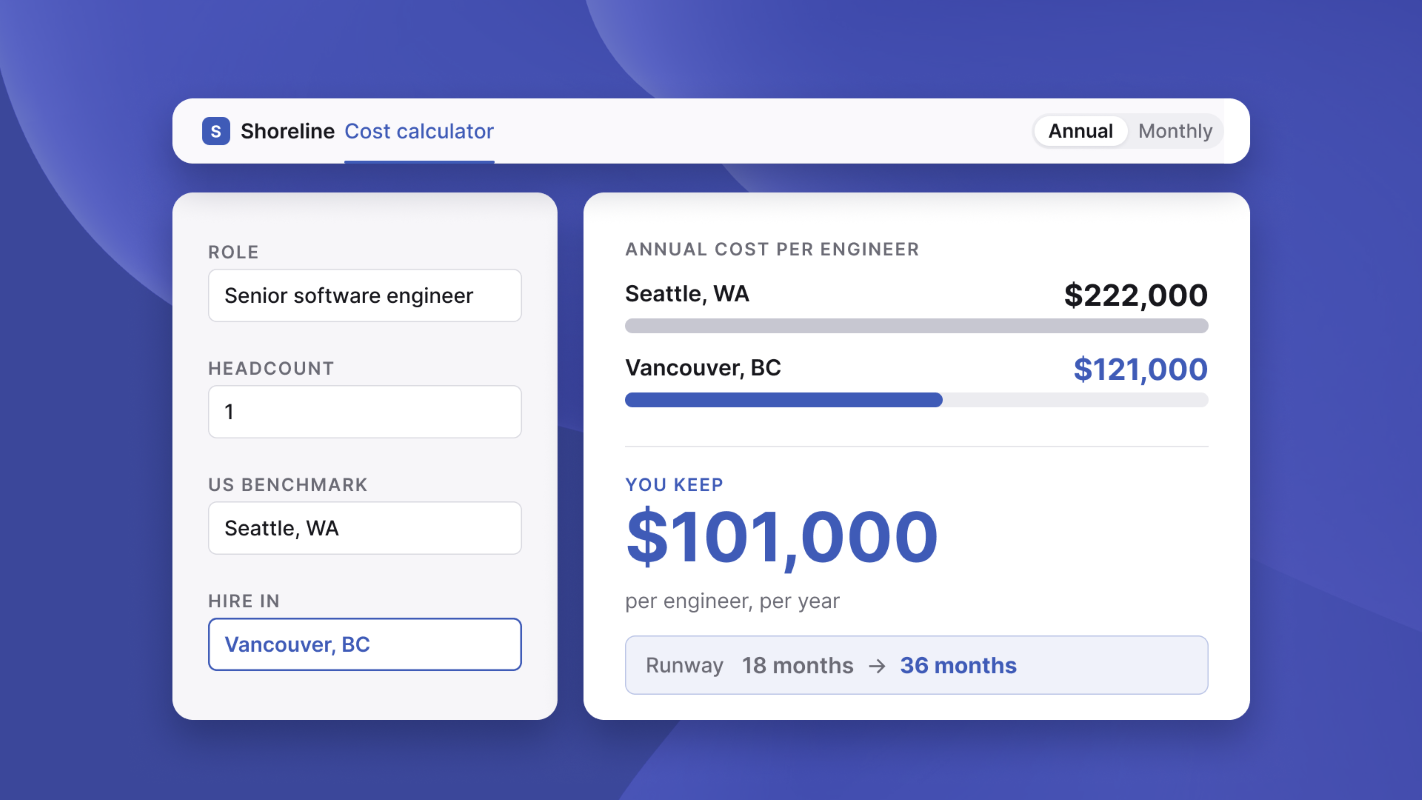
Want to see what a Canadian engineer costs all-in? Try our hiring cost calculator, or book a free consult and we'll walk you through it.