
2027 Canadian Payroll Changes: CPP and EI Rates Employers Need to Know


TL;DR
- The CPP rate drops to 5.75% each for employees and employers in 2027, down from 5.95%. It’s the first cut to the base CPP rate in over 20 years.
- The earnings ceilings rise to $76,700 for CPP and $87,400 for CPP2. The $3,500 basic exemption stays the same.
- EI moves to 1.64% on up to $70,800 of earnings (1.29% in Quebec), and employers still pay 1.4 times the employee premium.
- Most employees pay slightly less, about $108 less a year at a $70,000 salary. Earners above $87,400 pay slightly more: about $29 more for the employee and $44 more for the employer.
- Employers should load the new figures before the first pay run of 2027.
For 2027, the CPP rate drops to 5.75% each for employees and employers, the CPP ceilings rise to $76,700 and $87,400, and the $3,500 basic exemption stays the same. EI moves to 1.64% on up to $70,800 of earnings. Most people earning below the ceiling will pay slightly less.
If your company employs people in Canada, changes to CPP and EI contributions directly affect your payroll costs in 2027. The CPP base rate is decreasing, while contribution ceilings and EI premiums are increasing. Here's what U.S. employers with Canadian teams need to know, how these changes affect employment costs, and what to prepare before the first payroll of the year
The 2027 numbers at a glance
These are the CRA's published figures for employees working outside Quebec.
Sources: CRA CPP, CPP2 and EI tables, checked November 17, 2026.
Add it up and the most an employee can pay in CPP, CPP2 and EI combined is $5,798.12 for 2027, up from $5,769.52. The most an employer pays per employee is $6,262.57, up from $6,218.75.
What changed with CPP
The CPP rate falls from 5.95% to 5.75% for both sides, while the ceilings it applies to keep rising. The Canada Pension Plan (CPP) is the mandatory public pension that employees and employers fund together outside Quebec. Each side pays the same rate, and the employer remits both halves.
Why the rate dropped
The cut comes from Bill C-30. According to Finance Canada, it lowers the combined base CPP rate from 9.9% to 9.5% starting in 2027. Finance estimates that saves about $133 a year for an employee earning $70,000, with a matching saving for the employer.
The 9.9% and 9.5% figures are the combined base rate. The 5.95% and 5.75% you see on a payslip are the per-person rate, which also includes the first CPP enhancement layer. Both describe the same 0.20 point cut per side.
The $3,500 basic exemption stays put
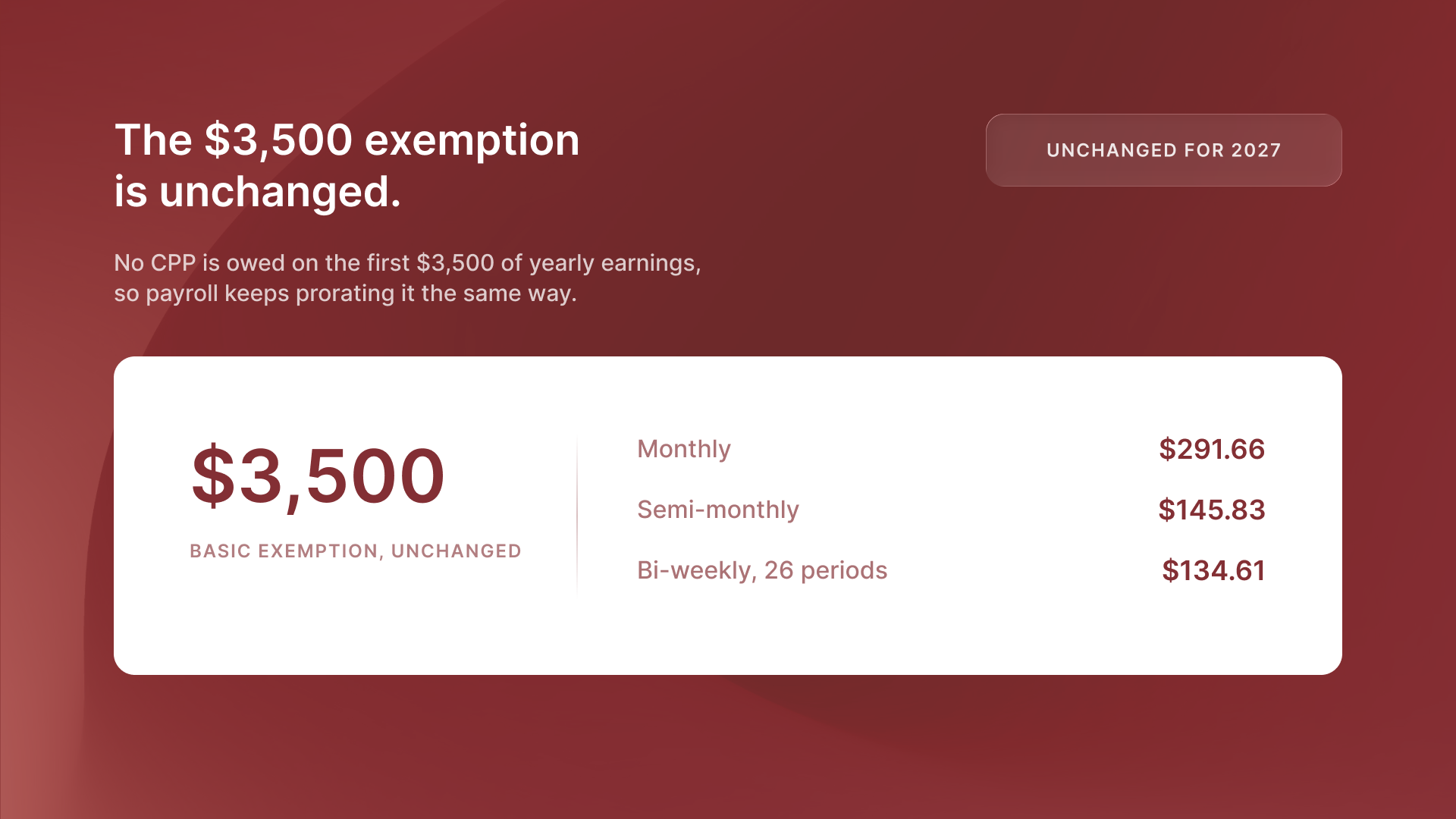
The basic exemption is the slice of yearly earnings on which no CPP is owed. It stays at $3,500 for 2027, so payroll systems keep prorating it the same way. Per the CRA, that works out to $291.66 per monthly pay, $145.83 semi-monthly and $134.61 on a 26-period bi-weekly schedule.
CPP2 still applies above the first ceiling
CPP2, the second additional contribution, is a 4% charge on earnings between the first ceiling (YMPE) and the second (YAMPE). The rate is unchanged, but the band moves up. In 2027 it covers earnings from $76,700 to $87,400, for a maximum of $428 each for the employee and the employer.
What changed with EI
EI premiums rise slightly: the employee rate goes to 1.64% and insurable earnings are capped at $70,800. Employment Insurance (EI) funds income support for people who lose work or take parental or sickness leave. Unlike CPP, EI has no basic exemption, so it applies from the first dollar.
The employer pays 1.4 times the employee premium, as the CRA's EI table sets out. That brings the employer maximum to $1,625.57 per employee for 2027.
Who pays more and who pays less
Employees earning up to roughly the CPP ceiling pay less in 2027. Higher earners pay a little more, because the higher ceilings outweigh the rate cut. We ran four hypothetical salaries through the CRA's 2026 and 2027 rates for an employee outside Quebec who works for one employer all year. The figures cover CPP, CPP2 and EI only, not income tax.
This pattern matters for budgeting. For a team of mid-level staff, 2027 brings a small saving. For a team of senior engineers earning above $87,400, every person hits all three maximums, so the employer cost goes up by $43.82 per head. That's not large, but it's worth knowing before you lock next year's headcount plan.
You can run your own numbers with Shoreline's income and payroll tax calculators.
What employers need to change
- Load the 2027 figures before the first pay run. That means 5.75% CPP, 4% CPP2, the $76,700 and $87,400 ceilings, the $3,500 exemption, and EI at 1.64% (1.29% in Quebec) on $70,800.
- Expect questions in January. Employees who maxed out CPP or EI in 2026 will see those deductions return on their first 2027 paycheque.
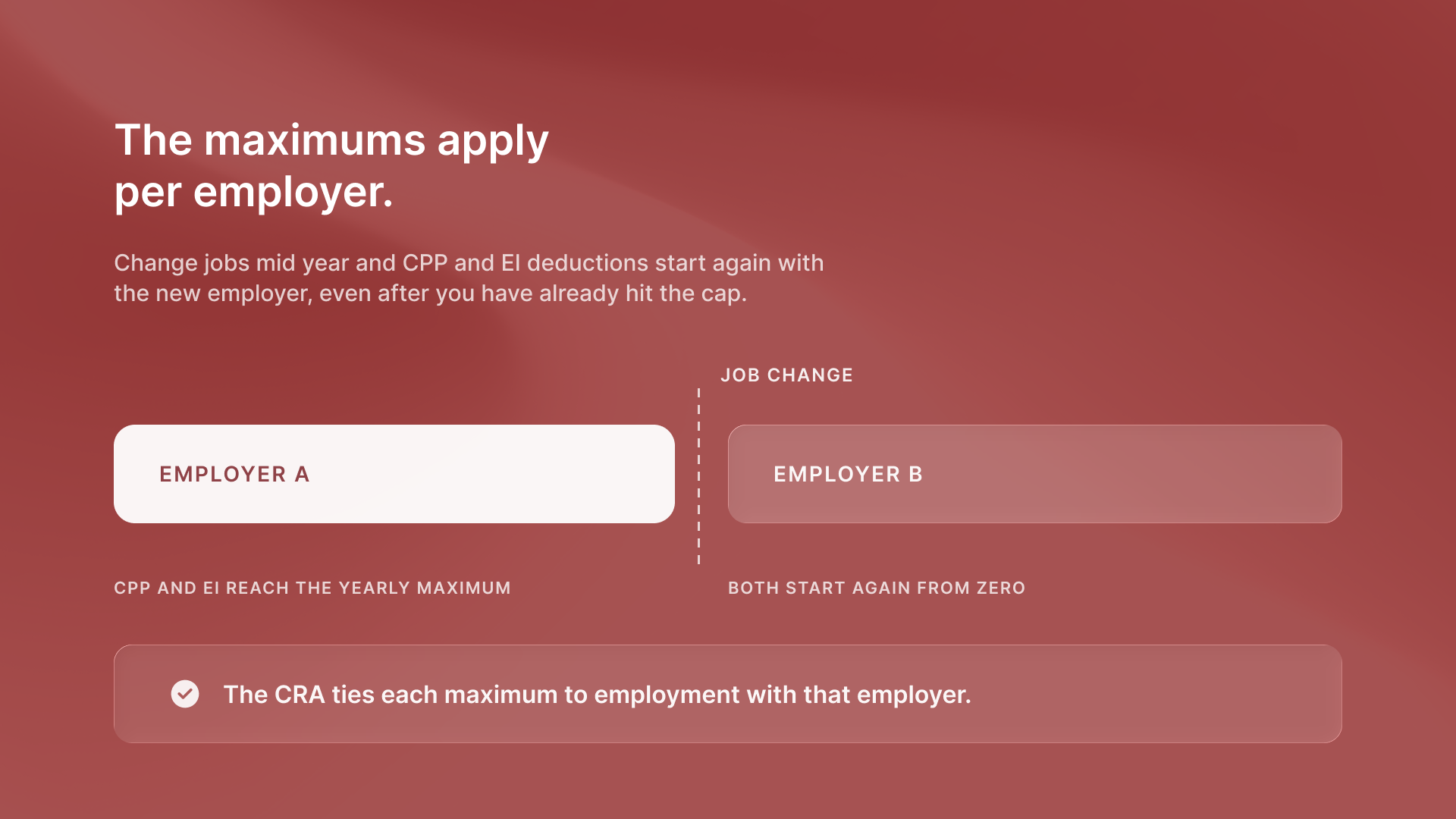
- The maximums apply per employer. The CRA ties each maximum to an employee's employment with that employer, so deductions can start again when someone changes jobs mid-year.
- Keep 2026 rates for 2026 pay. Pay dated in 2026, and the T4 slips that report it, still use the 2026 figures. Check with your payroll provider how they handle pay periods that cross the year end.
- Re-run your cost model. Use the table above as a guide: savings for most salaries, a small increase for senior hires.
What employees will notice
Most employees will see a slightly bigger paycheque in 2027, at least until they reach the yearly maximums. If you earn under about $76,700, the lower CPP rate works like a small raise in take-home pay, worth about $133 a year at $70,000.
If you earn more, you reach the CPP maximum a little later in the year and pay CPP2 on a wider band, so your yearly total may tick up. Either way, your CPP and EI deductions restart on your first paycheque of 2027, even if they stopped partway through 2026.
Quebec is different
Quebec employees pay into the Quebec Pension Plan (QPP) instead of CPP, and pay a lower EI rate because Quebec runs its own parental insurance plan. The CRA lists Quebec's 2027 EI rate at 1.29% on the same $70,800 cap, for a maximum of $913.32 for the employee and $1,278.65 for the employer.
QPP rates are set by Retraite Québec, not the CRA, so check its figures for Quebec employees. Quebec employers also have French-language and other obligations that are outside the scope of this article.
What to do next
- Confirm your payroll provider has the 2027 CPP, CPP2 and EI figures loaded by January 1.
- Re-run your 2027 budget for salaries above $87,400, which cost slightly more.
- Give your team a heads-up about deductions restarting on the first paycheque of the year.
- If you employ through an employer of record like Shoreline, these changes are applied in payroll for you. The budget impact is still yours to plan.
Planning your Canadian payroll for 2027? Shoreline handles Canadian employment, payroll processing and compliance for U.S. companies hiring in Canada. Book a strategy call and let our team help you manage your Canadian workforce without setting up a local entity.